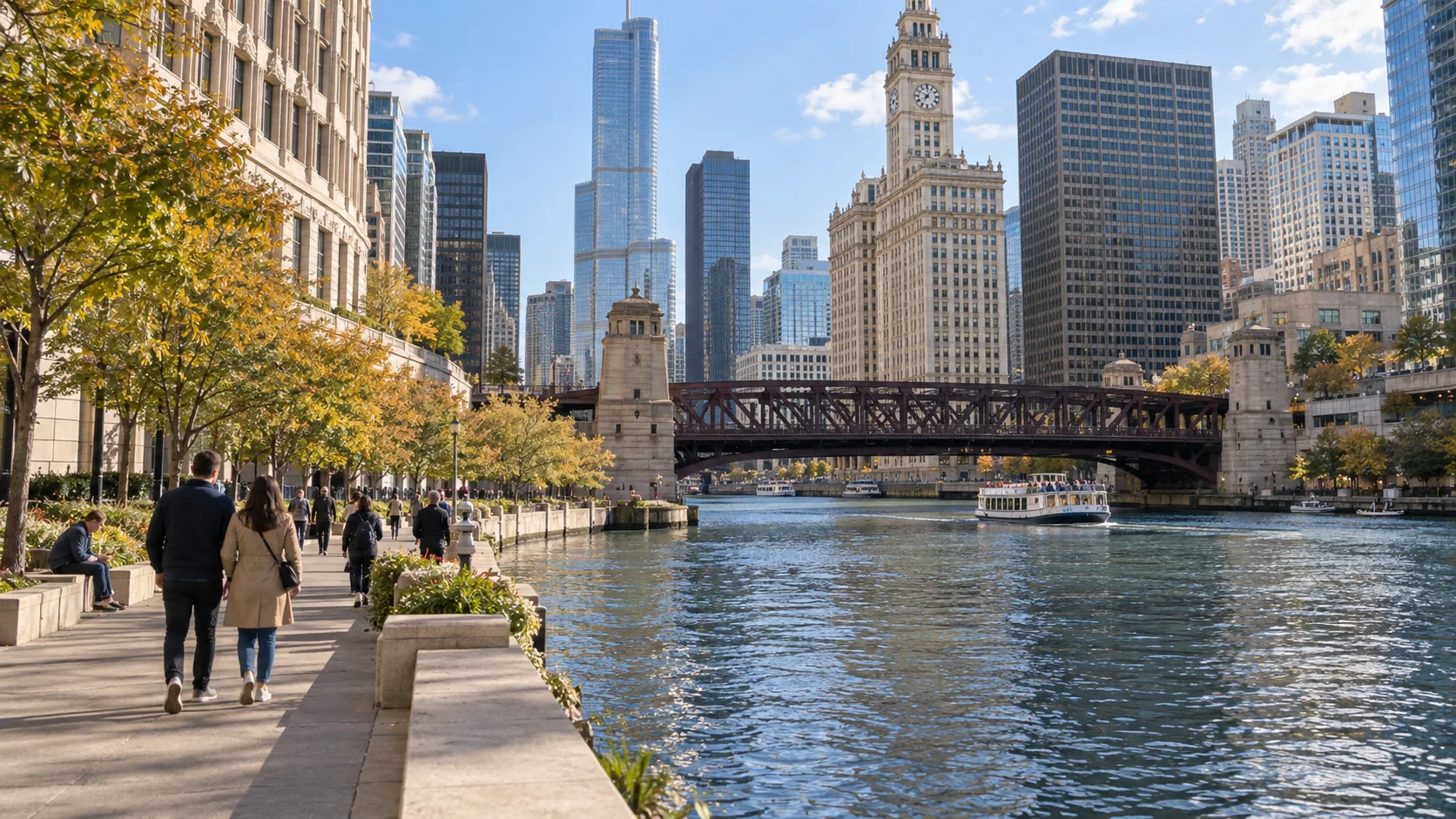
A good neighborhood walk is not necessarily the longest route on the map. It is one with a manageable arrival, places to pause, and a clear way to return if conditions change. Whether you are revisiting a familiar block or meeting a visitor, planning those ordinary details leaves more attention for the streets, public spaces, and small discoveries that make the outing worthwhile.
Choose an anchor and a realistic loop
Start with one place you particularly want to see: a public artwork, a park entrance, a historic building, or a stretch of the river. Build a route around that anchor rather than assembling a list of distant attractions. Check the position of entrances and crossings instead of assuming that two neighboring points on a map connect directly.
Decide where the walk can be shortened. A loop that passes the arrival point again gives a group a useful choice. A one-way route needs a confirmed return plan. Save the meeting location in a form everyone can recognize, including a street corner or entrance description rather than only a business name that may have several branches.
Check current access before setting off
Look at official information for the spaces you plan to enter. Construction, maintenance, events, and weather can change access. The Chicago Park District's park directory is a starting point for checking a specific park; confirm the relevant details on that park's own page.
For a group, ask about practical needs before choosing the route. A smooth-looking line on a map does not establish step-free access, suitable surfaces, or available seating. Check current accessibility information and make a backup plan if an essential facility cannot be confirmed. Avoid promising a route will suit everyone on the basis of an old photograph.
Make transit part of the plan
Identify the stop or station you will actually use, then look at the path between it and the meeting point. Check current service information through the Chicago Transit Authority. Allow for the walk from the platform or stop and for anyone who needs extra time finding the correct exit.
Keep the return journey visible. Save another nearby boarding point and agree what happens if the group separates. People should not have to follow someone else's phone continuously to know where they are. A short written route with the start, midpoint, and finish can be more useful than a crowded screenshot containing every possible attraction.
Leave room for the neighborhood itself
Schedule pauses instead of treating every stop as a delay. Look at public art, read a historical marker, or simply take in how a street changes from one block to another. Keep entrances, curb ramps, and paths clear while gathering as a group. Ask before photographing people closely and respect signs identifying private areas.
If the outing includes a cafe or indoor stop, confirm that it is open and appropriate for the group. A public bench or an alternative route can be a useful fallback, but do not assume that a private venue will provide facilities without a visit or purchase.
Review one detail for next time
After the walk, save a brief note about the entrance you used, the difficult crossing, or the quieter return route. Separate what you observed from what you would need to check again. Those small details turn a pleasant outing into a better plan for the next person, without pretending that a neighborhood stays unchanged between visits.